asakiyume: (shaft of light)
On the first day we spent together, my friend took me down to the edge of Yahuarcaca. That name goes with a group of lakes connected to the Amazon, los lagos Yahuarcaca, but she calls it/them río--Río Yahuarcaca. Like the main river, it inhales and exhales. The waters are at their highest in April or so, and then begin to recede. In June (when I was there this time) they're not at their lowest, but they've receded a good bit. So as you walk beside the water, you're walking in places where you'd be swimming at other times of year. You'd be waaaay under water in April, but in June you're on (more or less) solid ground, breathing air. The same trees that feed the terrestrial creatures drop fruit into the water to feed the water creatures at other times of year. They're watching over and providing for everyone.

"When the forest is flooded, this is a nursery for fish," my friend told me.

A fish nursery when the water is high

Wouldn't you feel safe there? A good place to grow big. It was the fishes' turn to be in this space a few months ago, but at that moment it was our turn. We're sharing the space, just time-slipped. Water creatures were swimming by and over me--time-slipped.

Trees must grow very wise indeed, presiding over two worlds like this. Think of the tales they can tell of all the creatures they watch over.

Genipa americana, known as huito in Spanish, é in Tikuna, is a very wise and generous tree. Francy told me it's a great-great-great grandparent of the Ticuna people.** So when she and her brother took me to meet a huito tree, I felt really lucky to meet it.

Its fruit is edible when ripe, and when unripe, it makes a blue-black protective dye (as described in this entry). In the blink of an eye, my friend's brother was up in the tree. He tossed down a couple of unripe fruits so we could grate them and make some dye back at their house.

ȧrbol de huito (Genipa americana)

**Online I found the story of this written out: Yoi and Ipi, two brothers, came to Earth when it was completely dark: they cut down the giant ceiba that was obscuring the sun, and all manner of plants and animals then were able to flourish. Yoi, the older brother, gave Ipi, the younger brother, the task of growing huito and then grating the fruits. Some of the gratings fell into the water and became fish, which later Yoi caught. The fish he caught became the Tikuna people.
asakiyume: (turnip lantern)
I didn't set out to do anything other than catch up with housework today, but then on a morning run I stopped to pick up a walnut fruit, and then that got me thinking about the staining capabilities of walnut, and then that reminded me of the Magüta/Tikuna people, who use the huito fruit (Genipa americana) to dye skin black. For babies there's ceremony where they're washed with its juice for protection. The juice doesn't start out black, but it turns black in the air:

(Screenshots from a lovely 13-minute video from Peru on the ceremony: Buxe Arii Ẽxüῧnechiga – Tinta de Huito Tikuna)

Here, they're washing the baby with the juice. You can see it hasn't yet turned black


And in this screenshot, you can see how dark black it gets


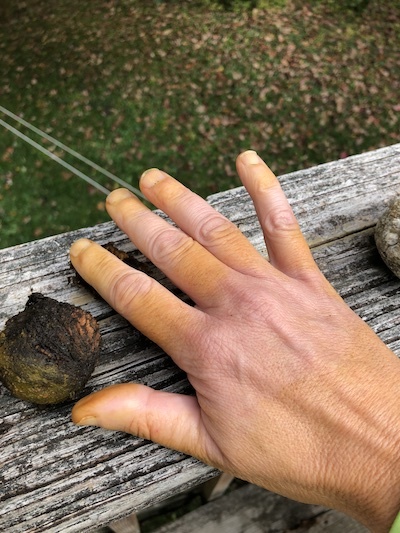
A similar thing happens if you're light-skinned and you stain yourself with walnut juice:

My hand in the morning--you can see the color is kind of yellow-orange


My hand just now, in the night


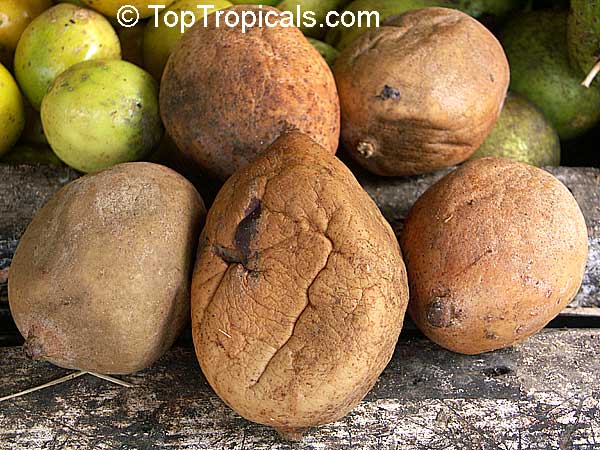
The huito fruits look kind of like the walnut fruits too, though they're not related:

huito:


black walnut (from Flickr user BlueRidgeKitties):
Black Walnuts in the Husk

... hmmm, maybe they don't look *that* similar.

After the video on the protective ceremony for the baby, there was a video on processing cassava to make the coarse fariña that I brought back, and I watched that one with great joy and happiness and took lots of screenshots. But I'll save those for another day.
asakiyume: (shaft of light)
This was a beautiful moment, yesterday


window to sky
asakiyume: (glowing grass)
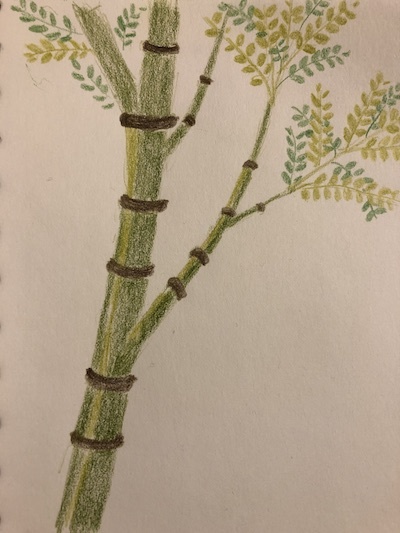
So here is what the tree in my dream looked like: like bamboo, but with leaves like a locust... except in this drawing, the joint-rings aren't raised enough-looking, hence the second, eye-searingly colored (expertly! with a mouse!) diagram/digital doodle to show you how the rings fit round the trunk and boughs.


Also...

Heard the first wood thrush of the season today. I was wondering how far south they go for winter--do they make it all the way to Colombia? ... Google says no; they winter in Central America. Google also tells me they're the state bird of Washington DC.
asakiyume: (glowing grass)
This is a secret world

wetlands

Where you can find marsh marigolds, tussock sedge, and skunk cabbage

marsh marigolds

tussock sedge

skunk cabbage

I went for a brief walk here with Wakanomori. Birds came and talked to us at eye level, little frogs jumped into the water. It was lovely.

-------

In other news, I dreamed of a tree with a growth habit and leaves like a black locust, but a trunk and branches that were segmented like bamboo, and smooth green like bamboo, only the joints, instead of being flush with the surface and pale colored, were BLACK and stood out from the surface as if they were arm rings or bangles that the trunk and branches were wearing. In my dream I stroked the smooth surface of the trunk and branches and the smooth, raised black joints and thought, What a remarkable tree--I have to look up what it is.

But of course it was a dream. It doesn't exist :(

However, when I searched--just in case--"black jointed bamboo," I discovered a type of black bamboo (but with pale joints) called Bambusa lako... Timor black bamboo. TIMOR.

It's very beautiful.
large photo )

Also, I finished translating my Timorese acquaintance's story, and we sent it to Strange Horizons. Hopefully they accept it!
asakiyume: (cloud snow)
I delivered** [personal profile] minoanmiss's postcard to the pine tree whom I had to deprive of mail some weeks ago (described in this entry).

It was close to sunset and the light was very long and golden.

late-day light

I took a video (it's 55 seconds) )

And here's a still photo

postcard for a pine tree

**I say "delivered" but I didn't actually leave it there; I just shared it with the pine tree the way you do with mail that's addressed to both of you. "We got a postcard from Minoan Miss! Let me show it to you and read it to you."
asakiyume: (turnip lantern)
Today I went out to mail a letter, walking through the woods, like I did the day I dropped a card by a pine tree. It was much warmer today, but the path through the woods was still covered with ice. If I had been wearing ice skates, I could have sped along it, my own tiny Rideau Canal.

ice road


On the way back from the post office, the clouds were thickening and the wind picked up, and I worried about trees falling on me. I never used to worry about this in the woods, but winds that bring down trees are much more common now. At home, I picked up mail from our postbox... and there was this postcard:


It's from [personal profile] minoanmiss --she sent it for me to share with the pine tree.

Isn't that great?

Next time I walk that route, I promise I will! Thank you, MM!

cold days

Jan. 28th, 2022 09:33 am
asakiyume: (cloud snow)
This past week gave us plenty of cold days for frozen bubbles. I blew one beautiful big one that floated up past my neighbor's pussy willow tree and eventually snagged in the upper branches of my apple tree:


(The black blob in the sky is a crow)


Tangled up


One day I decided to walk a birthday card to the post office--to get there I chose a path along trails and through the woods. There were many animal tracks. This photo is from a different day, but it gives the sense of the busy traffic:


Eventually I emerged from the woods, patted my pocket, and--oh no! No birthday card! It had come out at some point! So I turned around and retraced my steps and retrieved it from beneath a pine tree. I mentioned this on Twitter, and the Healing Angel responded:

Meanwhile, a very lonely pine tree droops when it realises that this courier was not for it, and that it will have to wait still longer for the letter it anticipates

OMG blood of my blood, soul of my soul.
asakiyume: (november birch)
I will joyously post if my cat comes home, so in the meantime ...

Well, here is something I loved on Twitter: Answer the question (link takes you to a one-minute TikTok video on Twitter).

I love this guy generally; his little videos are always hilarious, and the interactions between the two characters are so perfect, and oh the question!

So ... WHAT WOULD YOU BE?

On Twitter I said "I think I'd like to be as heroic, beautiful, and liminal as a red mangrove" --to which one of my Twitter friends replied that he'd like to be a black mangrove because those are the ones that have pneumatophores, the little breathing tube sticking up like straws from the sand.

--Bonus points if you noticed, as the ninja girl did, that the music playing in the background of the video is from Spirited Away.
asakiyume: (shaft of light)
The tropical storm brought down many trees around here (link is to a downed tree in my neighborhood). I made the mistake of going out in it and had two bits of tree debris fall on my car while I was driving (not damaging it, fortunately, but they were *loud* and scary), whereupon I turned around and went home and discovered we were without power.

Or almost. We have a solar battery (long story for another day...), which we got for just such an eventuality, and it gives us electricity for *some* circuits--like the refrigerator, yay! But not the stove, boo! Anyway, it's still something. Around us everywhere is the very loud hum--somewhere between a growl and a roar, really--of the generators of people who have generators.

Current estimation is that we should have power back by tomorrow at 10 pm. I'm very grateful this is happening in summer, not winter.

Today is Wednesday, and I want to talk about the next two short stories I read in Consolation Stories, because they were really *excellent*... but I think I'll maybe write my thoughts down on paper and then post the entry tomorrow.

... I was driving today and up ahead in the road two shadows were flitting, and I was afraid for a moment of running them over, even though really they were the shadows of birds high and safe overhead. It was strange, and I feel like there's a lesson in it.

ETA: We have lights again! And the stove, and my computer printer! Hurray!
asakiyume: (shaft of light)
They cut down a massive oak tree across the street from the supermarket. It was really huge, so huge a parent with two small children could have a picnic on the stump.

In situ

large oak by B'town Stop & Shop

My shoe, to give a sense of how large the stump is

size of oak stump

I thought, That stump would be a great place for a mandala-flower. So this morning I drew one:

chalk on oak stump

I might try expanding it ... or maybe I'll just leave it at that. I have until it next rains to decide!
asakiyume: (shaft of light)
When you see one bundle ....

bundle of fallen oak flowers

... there are likely to be more

tumbleweed clusters of oak flowers

These are fallen flowers from oak trees! Sometimes the tumble-bundles can get quite sizable.

Look at them lining this path

oak-flower path

Another photo:

IMG_0348

That one shows the trees, too--healthy and strong this year, so different from the years they've been under siege from gypsy moth caterpillars.

Musical note: here is a lovely tune from the 2003 Fullmetal Alchemist cartoon, played on a music box.
asakiyume: created by the ninja girl (Timor-Leste nia bandiera)
More Timor ca. 1960:
They also chant "songs of instruction" to the trees before they are hewn down, asking that they provide strong supports for the house and allow no harm to come to the family who will ultimately live within; and there are songs to encourage the Nautilus pompilius, to leave their sea bed and decorate the roofs of the most important houses with their shells.

That is a mighty fine tradition, and I wish we had it here. (I wonder if they still have it there.)

Here's a picture taken in 2006 by Flickr user giantpandinha of a house going up in Timor-Leste

On the rooftop

And here's another by her from the same year, looking up at those strong supports:

Solid house

There are different styles of house in different parts of Timor, but the ones King was talking about are the very distinctive house of Lospalos. Here's a photo taken in 1988 by Flickr user incitio.vacations

Raca Village, Los Palos - Timor Leste
asakiyume: (holy carp)
When I was telling my father about the fish elevator and all those shad, he told me that he'd learned from a friend that mountain laurel, which blooms around now, is known as "the shad tree"--because when it blooms, that's when the shad run.

He just called to tell me I'd misunderstood: It's not that mountain laurel are called shad tree, but that there's another tree, that blooms at the same time as mountain laurel, called shad tree. Actually, several trees in the genus Amelanchier go by that name, including this, Amelanchier bartramaiana, the mountain shadbush (also known as oblong serviceberry--ahh, names):


(Source)


(Here's a photo from Flickr of mountain laurel--not a shad tree or shadbush--by Flickr user Robert Ferraro--you can click through to see it larger.)
Kalmia latifolia - Mountain Laurel

He also told me that there was a law in Boston in the 18th century that you couldn't feed apprentices shad more than twice a week... which gives you a sense of its plentifulness at that time (and its low regard). (I searched law+apprentices+shad and found confirmation in a Google books excerpt from The Literary Era: A Repository of Literary and Miscellaneous Information (published 1901), which says,
From a recently published report of the Pennsylvania Fish Commission, it would appear that similar troubles were not unknown in eighteenth-century Philadelphia. The low prices of fish tempted many master mechanics to keep their apprentices on a lenten diet. Shad were particularly common and particularly cheap--so common and so cheap, in fact, that they were considered fit only for Indians, helots, and apprentices. The apprentices revolted ... The youngsters ... triumphed so far that the law relating to indentures was changed so that the boys "were not to be fed on fish more than twice a week." (p. 298)
asakiyume: (the source)
I picked some violets after a run today--I saw them on a hillside, a really rich, deep purple. At home I have lots of violets too, but the purple ones are more washed out. Then there are the white ones with purple veins, and best of all, the speckled ones.

Here they all are in a little vase:

violets

And here is a photo of one of those trees of gold that grow in fairy woods, along with trees of silver and trees of crystal. This one has been felled by a beaver. Look how beautiful its bark is.

golden bark

And here is a tree that has been gnawed at three different spots. Three beavers sharing a meal? Or one beaver not satisfied with the taste and hoping it gets better if he tries a different spot?

beaver breakfast table
asakiyume: (dewdrop)
It's cold today; the heater is chugging along, making my living space warm, and I feel so grateful. Outside, in the nearby city, the sparrows by the bus station are fluffed up like little feathered pokéballs. They're very tame; people feed them crumbs and things, either by accident or on purpose.

Around here people say "on accident," to go with "on purpose." How about the other way? By accident or by purpose.

Safe from the cold are these loquat trees I grew from seeds that [livejournal.com profile] 88greenthumb sent me. I've never eaten the fruit of the loquat--have any of you?


Their leaves are generously large and a rich green color, and apparently you can make a tea out of them, but I won't, because my trees are up against enough difficulties, growing in pots and kept indoors for half the year, without having their leaves plucked.

In China, and then by extension in Japan, the tree is called pipa (biwa in Japanese), like the instrument--maybe because the fruit look like it?

a pipa (source)


asakiyume: (shaft of light)


Here is a road I walk every day. This photo is from yesterday, but this morning, when I passed this way, an oriole flew into an apple tree (not visible in this picture) and seemed to be sniffing the blossoms. Maybe it was sipping nectar. Maybe it was nibbling the petals. Maybe it was listening to whispered secrets--I don't know.

spring road

These are not the apple blossoms that the oriole was getting intimate with, but these are apple blossoms I especially love, because they're on a tree I grew from a seed.

apple blossom

Beautiful May ♥

green way


asakiyume: (cloud snow)


I walked along this path and didn't stumble.

asakiyume: (Kaya)
On this day, Kaya took to writing her journal between the lines and in the margins of Trees of Insular Southeast Asia, which is not a pretty guidebook like Trees and Fruits of Southeast Asia but more like Wayside Trees of Malaya, created over decades by a scholar born in 1906:


Here is some marginalia in the copy of Lord Brabourne’s Letters of Jane Austen owned by by Fanny Caroline Lefroy and, later, her sister, Louisa Lefroy Bellas, who, as you can see, made corrections and added information (Source)


And here are some of Isaac Newton's own notes and corrections to his 1687 Philosophiæ Naturalis Principia Mathematica, because science folks do write in the margins too, even when they're not political prisoners (Source)

under the cut, as it's a bit big )

Along the way to creating this post, I happened to come across images of palm-leaf manuscripts--writing not about trees of Southeast Asia, but on their very leaves:

16th-cent palm-leaf manuscript; image source Wikimedia commons


The writing was incised, and then darkened with soot.

And, to bring the talk back to marginalia, I'll observe that Daniel M. Veidlinger notes in Spreading the Dhamma: Writing, Orality and Textual Transmission in Buddhist Thailand that

There are ... numerous interlinear corrections that are most often written in ink or lacquer, but are also incised into the leaves like the main text. (118)

Marginal notes by readers, on the other hand, are "completely absent."


Catalpa

Jun. 27th, 2014 10:27 am
asakiyume: (feathers on the line)
You know personal ceremonies or festivals, things you end up celebrating, year after year, just as an individual (or maybe, say, as a group of friends, or a family)--in other words, something that's not a broader cultural thing?

One of mine is the blossoming of the catalpa. SUCH A GLORIOUS TREE, with blossoms that look like they belong in tropical garlands (well, they are a bit pale, but so **fancy**), that rain down onto the street.

Here is the tree--can you see it is twice as tall as the rooming house it towers over?

catalpa in bloom

And here are the blossoms, fallen on the street and grass

fallen catalpa blossoms catalpa blossom glowing on road


The blossoms wear different colors of makeup to attract the bees. Some like a red-purple, like the one over on the lower left:

catalpa blossom, purple-red accent

Some go for golden-orange highlights:

catalpa blossom, yellow accent

And every year, I string them on long strands of grass and hang them up somewhere in the house.

catalpa threaded on grass

Happy catalpas, everyone!


Profile

asakiyume: created by the ninja girl (Default)
asakiyume

January 2026

S M T W T F S
     123
45678910
11121314151617
18192021222324
25262728293031

Syndicate

RSS Atom

Most Popular Tags

Style Credit

Expand Cut Tags

No cut tags
Page generated Jan. 7th, 2026 05:06 pm
Powered by Dreamwidth Studios