asakiyume: (feathers on the line)
Still not as online as I'd like to be, but here are some easy things to share. First, tendrils!

I planted some seeds from a passion fruit and got some seedlings, and I noticed the other day that they'd started sending out tendrils. Here one tendril is reaching round a ginger leaf:

passion fruit tendril reaching round a ginger leaf

I broke off a dried asparagus fern skeleton from the outside garden and brought that in for the passion fruit to climb on instead:

passion fruit seedling curling round a dried asparagus fern skeleton

And then I thought everyone could enjoy "Nope," demonstrated both by enlarged emoji and by Little Springtime. It was in my old hometown's public library for a display of picture books about saying no to stuff.

little springtime and nope sign

Now the verbal images. I was at R's place because I was going to take her and her kids to get green card photos, and I'd taken off my boots in the apartment. The boots are tall--they go to my knees. Her younger son looked at them standing by the door and said, "They're like military boots," and demonstrated marching. Which, wow. You compare a thing to things you're familiar with. I've been told the refugee camp these guys were in was close to active fighting.

And this last isn't so much an image as a metaphysical something-something. Or a failure of Google Translate. Or both. At a different point in the day, R and I were waiting in my car for her kids to get off the bus, and she typed a question into Google translate. I could see the English words change and rearrange themselves as she rephrased and added to the Tigrinya. The final result was:

How do I know what I don't know?

I wrote back, That's a very big question!

I think, based on her efforts to narrow down what she was asking, that she wanted to know about cars, about eventually getting a car, but the 10,000-foot-level question was a great one.
asakiyume: (yaksa)
Wakanomori shared a PDF of this (probably paywalled) article from the Atlantic, "The Costs of Instant Translation," by Ross Benjamin. This guy expresses so eloquently a lot of what I was reaching for in this post.

extensive quotes )

I'm not a literary translator, but I definitely am drawn by the cultural specificity of languages, the "shimmer of ambiguity," as Benjamin puts it. The creation, together, of meaning when the languages don't line up.

P.S. If the article is indeed paywalled and you'd like to read the whole thing, and if you're willing to share your email, you can message me and I'll email it to you.

P.P.S. Bonus: the part of his SNL monologue where Bad Bunny goes into Spanish
asakiyume: (yaksa)
As a kid, I learned English from English language cartoons on FilmNet. I learned from German TV shows. My passion for Swedish crime series taught me Swedish.

But now, the largest tv medium of our time, YouTube, has begun auto-translating everything. Future generations will not be exposed to foreign languages and be inspired to take an interest.
(Source)


Apparently the poster is talking not about auto subtitling but auto dubbing. Auto subtitling would be bad enough, but auto dubbing? Terrible. I too have relied on films, TV, and songs for every language I've ever learned. Having all the languages of the world put into English, ostensibly for my benefit, feels like having all the delicious foods that people cook all over the word turned into hamburgers and french fries because that's what I, as an American, am supposed to eat.

In science fiction, you get translation tech. Unless the point of the story is to talk about language (hello Darmok), this tech generally works flawlessly. In some stories, second-rate or old fashioned translation tech is used to humorous effect (Ann Leckie did this in one of her novels, and someone else I read in the past few years did too, but I'm forgetting who). But in all the stories, the tech is omnipresent and everyone uses it.

Obviously translation and interpretation services are hugely important. I want these services to exist. And I do appreciate what Google Translate makes possible. But there's a difference between having something as an option and having it inescapably, ubiquitously present. No one in Star Trek has to learn another language--ever. They just speak, and hear, their own.

This means their ears don't get to hear the different sounds that these languages make. The tones, the clicks, the trills, the glottal stops, the vowel and consonant clusters. (And we're not even getting into how the aliens may sound, if sound is even how their languages are embodied.)

But even worse, it means they can never be truly intimate with someone who speaks a different language. They can never be alone together, just the two of them. There's always a third party present, sliding neatly between them in bed, sitting with them at breakfast, standing between them as they contemplate where next to boldly go. It's just you and me and the translation software, my love. It's just you and me and our neural interfaces, which somehow will figure out how to convey circumlocutions, veiled sarcasm, passive aggression, tentative queries. These things can take us a lifetime to master in our mother tongue, but the tech is clever enough to do all that for us--across languages. In the end, do I love you, or do I love the translation tech? Cyrano de translation tech.

I'm thinking I might want to play with this in a story sometime: ardor driving someone to the boldness of learning their beloved's linguistic ways so they can speak with them face to face, no longer through a [tech] mirror darkly.
asakiyume: (yaksa)
What a breathtaking book Saint Death’s Daughter is. Truly magnificent in all respects: its exciting, imaginative story, its absorbing, immersive worldbuilding, its soaring writing, and its sharp, compassionate observations about human nature. I loved it completely.

It’s been a long time since I walked into a book and lost myself so entirely in it, so much so that I wanted to bring pieces of it back with me into this world. Can we have sothaín meditations, please? Can we have these twelve gods? … But just certain select pieces! Because the other thing about the world of Saint Death’s Daughter is that it’s cheerfully vicious and merciless—not always and everywhere by any means—but plenty enough. Take the fact that our protagonist, Miscellaneous (Lanie) Stones, comes from a family of assassins and torturers. And there are similar people in high places throughout the story. But the folks Lanie’s drawn to are nothing like that at all. We’re more than our family history, and we can make different choices—that’s the grounding hum that vibrates through the story. Lanie sets herself to make amends for the harm her family’s done: tries, fails, and tries again, all while growing into a powerful necromancer with a deep devotion to Doédenna, Saint Death.

There's so much! This is just scratching the surface )

So those are some of my reasons for loving Saint Death’s Daughter. It’s doing so much that it’s impossible to cover it all in a review. Lanie eventually learns to speak with more than one voice at once, with a surface voice and a deeper one (kind of like throat singing, where you sing more than one note at the same time, only Lanie’s deeper voice isn’t audible in the usual way of things). The novel is like this too: it’s speaking in a surface voice and in many other voices as well. It’s broadcasting on many frequencies; you can hear many, many things.
asakiyume: (shaft of light)
Waking up this morning was like waking up in the Amazon, and I AM HERE FOR THIS. Out my back window, a northeastern jungle, so many shades of green, dappled sun, morning mist. An aural bouquet of birdsong and small critter sounds. Right now there's a scent of wood smoke.

I love the way the medium of humid air makes you intimate with every other thing. The way everything is right on your skin and in your lungs. The glass of water sweats, you sweat. Time dissolves, sound travels nonlinearly, odors are more vivid. I love the lassitude, the exhaustion.
asakiyume: (feathers on the line)
It's a general truth of online life that you shouldn't read the comments--it's where the virulent nastiness lives.

Every now and then, that's not true though. After falling in love with the song "Xam Xam," by Cheikh Ibra Fam, I let Youtube take me on a tour of related songs.

It brought me "Gambia," by Sona Jobarteh, a beautiful song written to celebrate 50 years of Gambian independence (in 2015).

I happened to glance at the comments, and--my heart!
I'm a German, 55 years and my husband was a Gambian. He died here in Germany in 2011 (cancer). Today he would have celebrated his 62nd birthday. In 1998 he took me to his country and we spent there two years. This was the most beautiful time in my life. For the first time in my life, I felt like real living – I felt alive like never before. So I want to say "thank you" to my husband again, who showed me a place where my soul could breath. Whenever I feel down, doubting what this life is all about, I go back in my mind and think of those glory days.

And this...
Oh, i can recognise my grandmother at the end of this clip dancing with a group of women's. Thank you sister sona for futuring my granny. This will go down in history. Gambia for ever true.

And this...
I am from Ukraine and this music made me cry. It touches something deep in my heart. I think we missed Africa and we miss it. I play it and dance in the kitchen. I would like the whole world to go out in the streets and dance African dances. As not only live in our brains, but also in our bodies and our hearts.

And this..
From Somalia 🇸🇴 much love ❤️ our brothers & sisters 🇬🇲 beautiful country & beautiful people ❤️

And on and on...

"Am from Uganda ... I am from the Caribbean ... I'm a dutch old (63) man ... I'm latina from Colombia ... Je suis de la Côte d'Ivoire 🇨🇮 ... I'm Argentinian ... I'm a Proud ERITREAN-AFRICAN ... I am from India ... I'm a japanese student ... I'm from Morocco ... I am welsh ... I am from Spain ... I am white African from Mozambique ... I'm Nigerian ... I am peruvian ... I am from Croatia ... I am from Bangladesh .... I am Congolese... Sending love from Ghana ... Greetings and best wishes from Latvia..."

(And several from the United States, too.)

All full of love for the song. Really made me feel like part of one human family.
asakiyume: (the source)
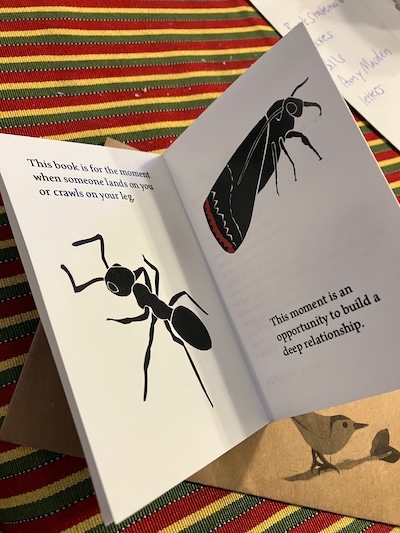
Over on Mastodon I was made aware of the existence of this beautiful little zine, done in the traditional way (all printed on a single sheet of paper), Meditations with Insects: An Art of Noticing, so I decided to order it.

It came in a brown envelope with drawings of a beetle, small bird, and owl on it, and the sender was "Unfolding Connections."

cover of "Meditation with Insects: An Art of Noticing

It was everything I hoped for and more. The main text directs readers to quiet, curious attention to creatures often ignored or disliked:

drawing of an ant and a moth, with text

And then, wonder of wonders, there's text on the reverse side, too: quotes about recognizing and appreciating the presence and wisdom of other beings--unfolding connections to make ;-)

a quote from Dingo Makes Us Human by Deborah Bird Rose

That quote has a typo, but it's the one that got me choked up reading it aloud to Wakanomori.

I really loved this one, too:

"the world is full of persons
only some of them human
and life is always lived in
relationship with others"

--Graham Harvey, Animism: Respecting the Living World

The creator, Kristian Brevik, has a Patreon, and he also makes lanterns of sea creatures that when lit up show the creatures' skeletons. Seems like a very cool guy.

And here's a photo from a week or so ago of some bright yellow coltsfoot pushing up through the leaf litter.

yellow coltsfoot (look something like dandelions) poking up from brown leaves.

... I offer these as necessary nourishment in the harrowing landscape we're navigating right now.
asakiyume: (Dunhuang Buddha)
Billy Behind Me, who was a character in the Patricia Russo flash story "Mena, Until," which I talked about back in February, makes an appearance in the second of this trio of short poems.

I like everything about that poem. I have a broken pot whose shards I want to try drawing with (though I have brilliant street chalks, so I don't really have the need--but it's the principle of the thing).

The end makes me think of how we talk with people when we can't talk to them in the waking world anymore. How we talk in dreams. Makes me think of what Ailton Krenak says, and about what the characters say in Embrace of the Serpent, and also of the story The Lathe of Heaven.


Some music for you: Baixi-Baixi
asakiyume: (the source)
We went for a walk at Bright Water Bog in Shutesbury, MA, yesterday. It was a misty, moisty, equinoctial day, with ice still present in places.

It was perfect. I do love-love-love places that blur water and land. Best of all? There were cranberries. Enchanting.

Cranberry, lower portion of the photo
cranberry

two more photos of two other cranberries, in case, like me, you can't get enough of them )

I saw a few just out of reach and was going to put a foot off the boardwalk and onto a tussock to pick one.

"I don't know if that's solid," Wakanomori said.

So I pressed on it with my hand, and down, down my hand went into that cold water. Not solid! Magic.

Canada geese or maybe otters or moose deliver mail here, I think:
mailbox

Actually it's a geocache location.... shhhhhhh

This lichen-bespangled pine sapling is enjoying the acidity of the bog.
bog pine with lichen

So much beauty--a mingling world of blurred boundaries.
Bright Water Bog
asakiyume: (cloud snow)
[personal profile] sovay linked me to a story from 2012, "Aquatica," by MC Clark, in which a male anglerfish's effort to avoid his own biological drive and the blandishments of a female anglerfish lead to profound conversations. Really gripping story that creates a full, meaningful vision of the anglerfish life cycle--which is one of those life cycles that seems really alien from a mammalian point of view. It's easy to sympathize with the male anglerfish's desire to outrun biological determinism, but it's not merely survival he's after--as the female anglerfish points out, death comes either way--it's wanting to perceive or understand something more than just the cycle.

* * *


On the way to visit my dad on Christmas Day a small murmuration passed over our car. It was breathtaking--thinking about it makes me stop breathing. Dark bodies, wings, pale sky--a tessellating collectivity. Then on our way back later in the day, we saw bobcats in a meadow. Bobcats are so strange, if you're used to domestic cats: they're like someone has taken a domestic cat and given it extra-strong, extra muscular legs... and reduced its tail.

* * *


Saw this and wasn't sure at first whether it was a branch on the path or the shadow of a branch.

shadow or branch

(It was a shadow)
asakiyume: (shaft of light)
In The Mountain in the Sea, Ray Nayler made the fact that octopuses were able to write a central part of what indicates they're advanced (a character says, “Yes, they have writing… which is an enormous leap in cultural evolution”)--a hugely ethnocentric notion.

So it's very affirming to read Natalia Brizuela's introduction to another brief collection of essays by the Indigenous Brazilian activist Ailton Krenak. (The collection is called Life Is Not Useful.) She writes:
Yasnaya Aguilar, the Mixé linguist, writer, and activist, reminds us ... that Indigenous people do not have “oral traditions,” but rather “mnemonic traditions.”8 ... Western modernity, with its countless institutions and homogenizing temporal framework, always sees the oral as preceding the written, as falling somewhere behind in the chronology of development. But as Ailton and many other Indigenous people explain, the practice and activation of memories – through dreaming, singing, dancing, storytelling, and various other activities – are ways of belonging to and sustaining the cosmic sense of life.

8 See Yasnaya Aguilar Gil, “(Is There) an indigenous Literature?”, trans. Gloria Chacón, Diálogos 19.1 (Spring 2016), p. 158.

She goes on to quote Ailton about the importance of listening and then to unfold that:
“Either you hear the voices of all the other beings that inhabit the planet alongside you, or you wage war against life on earth” (p. 38) ... Listening means being alive, staying alive, and keeping the ecosystems to which one belongs alive as well. Listening is caring. Not listening brings war: that is, a type of destructive encounter, a form of non-co-existence. We listen with our entire bodies, not just our ears ... Our bodies are part of and an extension of the Earth. If we allow them to become sensing instruments for dreaming and conversation, the cosmic sense of life would not be so threatened.


I love this statement: We listen with our entire bodies, not just our ears.
asakiyume: (shaft of light)
There are rivers whose personhood has been recognized--in New Zealand, Colombia, Bangladesh, Canada, elsewhere too. And now, on the occasion of COP16, the 2024 UN Biodiversity Conference currently underway in Cali, Colombia, there's a legal petition to have Ecuador's Los Cedros cloud forest recognized as a co-copyright holder for a song, created by writer Robert McFarlane, musician Cosmo Sheldrake, mycologist Giuliana Furci, legal scholar César Rodríguez-Garavito--and the forest.

In this Guardian article, McFarlane says,
It wasn’t written within the forest, it was written with the forest. This was absolutely and inextricably an act of co-authorship with the set of processes and relations and beings that that forest and its rivers comprise. We were briefly part of that ongoing being of the forest, and we couldn’t have written it without the forest. The forest wrote it with us.

The organization they're working through is the More Than Human Life (MOTH) project, which describes itself as "an interdisciplinary initiative advancing rights and well-being for humans, non-humans, and the web of life that sustains us all." They have a book, MORE THAN HUMAN RIGHTS
An Ecology of Law, Thought and Narrative for Earthly Flourishing,
edited by Rodríguez-Garavito, which is free to download on their site (link here), as they want people to have access to the ideas and thinking.

In other news, an owl perched in a lilac right by our door this morning, looking for all the world like a person in a parka with a fur-lined hood. Her feet were invisible where she perched, her eyes were black and only black when she swiveled around to look at Wakanomori and me. We had come to see what the disturbance was--crows were making such a racket. Apparently they don't like Madam Owl.
asakiyume: (feathers on the line)
The teacher I used to work with in Holyoke asked me back to give a talk on writing to her high school-aged students, who are working on personal narratives. These are all kids for whom regular high school hasn't worked out, but they are still fighting for an education and a future, and the teachers at this program are 100 percent dedicated to helping them with that.

This happened in front of the building housing the program. This is these kids' daily life.

We talked about what makes writing hard, and how you have to strive to write in a way that your readers will understand and feel what you're sharing--even if your reader is only your future self. It's too easy to be cryptic or use a sort of shorthand that speaks to you in the moment but not later. And of course if your audience is going to include people other than yourself, you have to work even harder. Learning what you need to improve is good--but we also need reassurance and praise for what we're doing.

the writing exercise I did with them )

Afterward, I answered questions and the talk drifted to (among other things) languages. I think I maybe went overboard talking about how learning languages made me positively high, but it led to a touching conversation on my way out with a student who confided that he'd started teaching himself Hebrew.

"Oh wow, Hebrew!" I said. "How did you choose that? Is it part of your heritage?"

"No. It's because of ... You know. The news. I thought of doing Arabic, too, but the letters seemed too hard."

I felt so much love for that kid in that moment. What a profound response to what's going on. What an instinct for healing.

So take heart, everyone. You can be a kid growing up in a neighborhood where stray bullets kill babies, and yet you're teaching yourself language to Tikkun Olam the hell out of our broken world.
asakiyume: (feathers on the line)
When Crinklewing (as my husband dubbed him) was blown away, I thought that was the end of the story, and so I made the entry with that endpoint.

But stories keep flowing! So much of storytelling is about deciding where to begin and end your tale ...

Later that day, I found Crinklewing again in my yard. All through the day, I took breaks from work to continue what I described in the last post, taking him to different flowers, tempting him with sugar-water. As evening came round, he climbed up on my sweatshirt, right up to my neck! And then he fluttered off, back into the milkweed patch by my door.

Or so I thought: later I found him on my kitchen floor.

All right, friend, spend the night here in my house, where it's warm, I thought. I put him on a brightly colored piece of cloth on my ironing board and wet it with sugar-water.

proboscis out!
crinklewing overnighting

Today is another sunny day. I don't want Crinklewing to end his days cooped up in a dim indoors, so I decided to take him to a pollinator garden by an elementary school. It's a beautiful place, and he looked at home stretched out on a ... not sure what it is. [ETA: Likely Tithonia, also known as Mexican sunflower--ID courtesy of [personal profile] pameladean--thank you!] A bright flower.

crinklewing on a flower

But I heard a group of kids and a teacher coming along, and I realized in this spot, he would be vulnerable to lots of people noticing him and possibly poking at him. So I took him down the hill to a wild spot with lots of goldenrod (which has delicious nectar beloved of bees and butterflies) and set him there. Lots of food, and warm sun.

crinklewing on goldenrod

As I came up the hill, one of the little kids greeted me. "Hi! How are you? What are you doing?" And I realized the group was a special ed class (not from the greeting, from other things). There was one child in a wheelchair with a screen for touching for communication.

I told the kid about Crinklewing.

"Can we go see?" the kid asked.

"Let's just look from here," the teacher said. "It's better for the butterfly."

That seemed to satisfy the kid. He and the others got busy exclaiming over the flowers, squatting down to look at things, asking questions--clearly learning and enjoying themselves.

All crinklewings of one sort or another. It feels too on the nose, but it's really what happened.
asakiyume: (feathers on the line)
I've spend the last two-and-a-half days thinking about and trying to care for a butterfly who came out of its crysalis with a malformed wing. It's as if something got wrapped around the wing and pinched it. Here's the picture I took on the day I noticed it (two days ago):


That day was a sunny day and warm, a good day to enter the butterfly stage of your life and take flight. At first I thought, maybe it can pump enough fluid into that wrinkled wing to get it to unfold. But no, it couldn't.

So it was doomed. It was never going to be flying anywhere. Butterfly raising web pages told me I could make a pet out of it, or I could euthanize it (methods described, nothing awful but the concept was very depressing)--or, unstated, but clearly a choice, I could just leave it be, in which case it would die all on its own.

It was such a sunny day. This is life in the world as a butterfly, friend, I wanted to say. You can't fly, so your life is destined to be quite brief, but I hope you really love this sun. It must feel strange not to be a caterpillar anymore.

Then yesterday was rainy and cold. The butterfly hung on to its spot all day. I brought it flowers because one thing the butterfly raising pages said was you could offer a newly hatched butterfly an array of flowers. But it was too cold a day, maybe, for the butterfly to try to test out the flowers. And I don't know how long the nectar stays nectar-y after the flowers are cut.

Today is sunny (ish), and the butterfly was walking about a little. I read on the butterfly pages about making a honey-water or sugar-water mixture. Put it in a saucer and let them taste it with their feet, the page said. When they realize what it is, they will drink some, if they feel like it.

two more butterfly pictures, with the flowers I tried tempting it with )

So I made some honey-water and held it where the butterfly could taste it, and it did taste it, and then climbed onto my hand--but when I lifted my hand, it fell fluttering off--but then gamely caught hold of a twig and started climbing up again. I tried again to interest it in the honey-water, and again it climbed onto my hand. I thought I'd carry it over to a stand of cosmos--then it could do the butterfly thing of drinking nectar, have another experience of life as a butterfly before it died. So I walked very slowly and carefully, and the butterfly sat on my hand, calm.

And then a big gust of wind came and carried it off, I don't know where. I looked around my yard, but couldn't see it. But I'm thinking, this means it even--sort of--experienced flight, a little.

I'm glad to have known this butterfly.

Meanwhile, I have a chrysalis on the siding of my house that's just about ready to hatch. I hope it will be healthy and able to fly.
asakiyume: (feathers on the line)
I wanted to try to bring some of the good things that I saw in neighborhoods in Leticia to my neighborhood in western Massachusetts--the sense of (mild) commerce and work mixed in with homes, of people doing things by foot or small transport, right in their neighborhoods, interacting with each other in the spaces by their homes rather than life lived in a series of space stations (the home station, the work station, the shopping station, the kids' activities stations) only reachable in your spaceship, which you pilot through the vacuum of space.

To that end, I decided to press the little wagon that [personal profile] wakanomori had built for my bicycle into service to sell ice creams in the neighborhood. But not to earn money: for one thing, I already have a job that earns me much more. For another, I think it would be, shall we say, confusing for my neighbors. But selling things for a cause is okay: people are used to that idea. One of my neighbors was super enthusiastic about the idea and came up with the notion of choosing a different local cause each week to raise money for (and suggested that we do rounds once a week all through the summer). The advantage of two of us is that if one of us can't do it, the other one can take charge.

The Icicle Bicycle--not yet loaded with ice cream, but with a llama balloon.


So we launched the Icicle Bicycle! We've done it for three weeks now, and it's gotten (touch wood) really good reception so far. We have some repeat customers, and each week some new ones. We get parents with little kids, teens on their own, and adults. It's wonderful!

Last week was also Tanabata, Japan's version of the pan-East Asian star festival, which commemorates the one day a year when the Weaver Maid and the Oxherd Boy (aka the stars Vega and Altair) cross the Heavenly River to see each other. Japan celebrates it on July 7, and one of the traditions is to hang wishes on decorated branches of bamboo. So I invited people who were buying ice cream to hang wishes on a branch of, uhhh, burning bush:


I kept the branch in my front yard for a few days for people to enjoy, but rain was causing the wishes to fall off, so I took everything down, and I confess I read the wishes. And oh my heart, such a mix...

Tanabata wishes )

Please join me in praying for all these wishes to be fulfilled, especially the one about the father.

And if you're in my neighborhood on a Friday around 6 pm, you can pick up an ice cream for a dollar ;-) This week's cause is our town library. I'll be away, but if it doesn't rain, the Icicle Bicycle will be making rounds.
asakiyume: (miroku)
The other day Netflix laid some real wisdom on [personal profile] wakanomori and me in the form of a conversation in 逃げるは恥だが役に立つ (The Full-Time Wife Escapist). I recommend this short series! It's funny and insightful, and its characters are unusual and likable.

The wisdom was in what the awkward, shy male lead (Hiramasa) says to the female lead (Mikuri) in a key moment. She's just said that Hiramasa doesn't need to put up with all the bother and trouble that a relationship with her entails and run off to her "office" in the bathtub.

He speaks to her through the bathroom door:
Subtitles first, actual dialogue second
If you avoid things that are troublesome and avoid them as much as possible, you'll end up hating even walking and eating. You'll hate even breathing. You may as well be dead, right? Life is troublesome.

面倒を避けて避けて、極限まで避けて続けたら、歩くのも、食べるのも、面倒になって、息をするのも面倒になって、限りなく死に近ずくんじゃないでしょうか。生きていくのって、面倒くさいです。

He then pivots to talking about how, if life is troublesome whether they live together or separately, they might as well live life together and face those troubles together--but what struck me as wisdom was his recognizing that you can keep on cutting troublesome things, irritating things, bothersome things from your life (if you're so lucky as to have the means to do so), but among the things that remain, there'll be something that rises up to take the place of the things you've gotten rid of. You could pare your life down to eating and sleeping--or walking and eating, as he says--and you'd end up finding those things a bother.

And this feels true to me! And it feels especially ominous as it gets to the point when things we actually like doing are whisked away from us in the name of removing a burden, to the point where now you have AI being promoted as being able to write that pesky paper for you, or to help you out with that scene in a story.

We need to resist having the things that make life worth living taken away from us. We don't write stories or compose music or paint paintings or knit sweaters or grow vegetables because we're the best ones to do those things--we do them because they're what make life life: this is what it means for us to be alive. No, I don't want a machine to write a story for me--that is exactly what **I** want to do. Even if I'm not the best at it. And while we're defending our right to the fun stuff, we might also want to reclaim some of the stuff that's more widely acknowledged as troublesome. I'm not saying give up a convenience you truly love, but if there's something you don't mind doing, embrace doing it.

I'm reminded of Nate Masters, a visitor to the Martin Luther King memorial when it was first unveiled in August 2011. I blogged about him back in the day, but that entry is now locked, so I'll paste in the quote here:
You live long enough, son, you're going to have some stories too, I assure you. That's the way this thing is, you understand? We have stories. If we make it through the day, you understand, and rejoice in the morning, we'll make it, you know, peace in that day. It's not hard, life is not hard. It's just a little troublesome sometimes, you know? Just make it through the day, that's all.

(Here's a link to the NPR story, if you want to hear his voice.)

neighbors

May. 16th, 2023 07:14 pm
asakiyume: (feathers on the line)
I was in the supermarket, and an old guy came up to me--I thought I recognized him--and he asked, "Are you my neighbor?"

In that moment I realized who he was: he lives at the top of a cul-de-sac in the housing development I live in; his house is unlike any of the other houses in the development, a totally idiosyncratic pattern, never quite finished, with cinder blocks propping up the porch and real wood shingles instead of vinyl siding. I think he lives alone, except for his dog: he always has a golden retriever friend. He grows flowers and vegetables. He's always friendly whenever I'm with my friend, another person in the neighborhood, and we walk past his house.

"Yes, yes I am. You live in the house at the top of the XX cul-de-sac. You have a golden retriever."

He smiled. "Yes, yes, I do. Well. It's nice to see you."

"You too."

I don't know if just putting those words down conveys how special the moment felt.

Back at home one of the little girls who live to my left was sitting inside her house at the front window, which was wide open. She had some kind of tablet in front of her; she was focused on that, but at any moment she could look up and see whatever happened to be going on out front.
asakiyume: (squirrel eye star)
I first came upon this poem in 2007; I love it. I shared it back at the time, but that was 16 years ago, so I'm sharing it again--this time with illustrations. (Some of them are click-through-able to the original person's photo on Flickr... others are just shamelessly ripped from stock photos and what-have-you.)

"A Love Letter" was originally published in a collection called Break the Mirror.

A Love Letter, by Nanao Sakaki )

Jennifer

Apr. 21st, 2023 07:29 pm
asakiyume: (feathers on the line)
A kid came up to me in the early evening of my first full day in Leticia as I was going into an eatery. She was skinny, with hair going every which-way and dark patches on her face that might have been bruising or dirt or a birth mark. She said something to me that I didn't quite understand--but I suspected that she was asking for money, so I opened my purse to get out some money.

"No, no," she said. And then something else ending in "sopa" (soup).

"You want me to buy you a soup?" I asked.

She nodded.

So we sat down at a table, and when one of kitchen staff came over, I ordered fish for me and a soup for her--and with my eyes I tried to ask silently for indulgence/forgiveness/understanding because I know that one person's idea of a good deed can cause trouble for other people, but the woman just nodded, like she did understand and wasn't troubled.

I asked the kid how old she was, and she said eighteen. I highly, highly doubt this, not just from her size, but from the way she acted. But maybe she truly was: not getting enough to eat can stunt your growth. Or maybe she had reasons for claiming to be not-a-minor. I asked her what her name was, and she said "Jennifer," pronouncing it like an American. I asked her if she had any brothers or sisters, and she said she had older brothers.

The woman brought out a soup.

"And can I have a soda?" Jennifer asked. So I got her a soda.

"Boy they sure are slow here bringing you your fish!" Jennifer said in a loud voice. The women at the next table, who were wearing uniforms for the Claro mobile phone company, looked over, frowning.

"It's fine. The fish takes time to cook," I said.

"I think they're just SLOW" she said. And then, brightly, "Hey, when it comes, you'll share your rice, won't you?"

"Sure, okay," I said. And I asked the woman from the kitchen if we could have two plates.

Eventually the fish came, and I put half the rice on the second plate.

"And can I have some of the fish, too?" Jennifer asked.

"Okay," I said, and gave her half the fish. This was fine: I couldn't have finished the whole thing anyway.

She ate with food-flying gusto, sometimes shooting rude remarks to the kitchen staff, who replied that she'd better behave herself or they'd call the police, whereupon she offered her thoughts on snitches who call the police.

At other moments she seemed about to fall asleep into the plate, her eyelids half closing. I suspected narcotics rather than exhaustion, and the fact that she put a teeny-tiny twisted plastic bag of something on the table strengthened my suspicion. But she always roused herself.

After she finished eating, her remarks to the staff got more provocative, and they repeated their threats. I felt anxious and sorry--anxious that we were well past wearing out our welcome, sorry for the employees, sorry for the other customers, and extremely sorry for Jennifer and her situation.

"Jennifer, you've had something to eat. Maybe now would be a good time to leave?" --I said this knowing full well that she likely had no place to go to.

"Okay," she said equably, and sauntered out. One of the Claro employees offered her a half-empty bottle of soda, and Jennifer took it.

After she left, I apologized to the Claro women and the kitchen staff, and everyone said no, no, it wasn't a problem at all. I asked the kitchen staff what Jennifer's story was, and they said that her parents were likely drug addicts and that she lived on the streets.

I didn't ask about social services. I know there are some around--I looked, later on. But there are always reasons why, and times when, what's available doesn't help, as I know only too well from how things work here in the United States.

I can imagine Jennifer's story any way I want. I can imagine that she finds her way to people who help her out. That she's able to escape the road that seems mapped out for her. But my imaginings are only that: imaginings. In the end all I actually did for Jennifer was provide one meal.

Profile

asakiyume: created by the ninja girl (Default)
asakiyume

January 2026

S M T W T F S
     123
45678910
11121314151617
18192021222324
25262728293031

Syndicate

RSS Atom

Most Popular Tags

Style Credit

Expand Cut Tags

No cut tags
Page generated Jan. 3rd, 2026 04:29 pm
Powered by Dreamwidth Studios