languages-lifeways-connections
Nov. 20th, 2023 09:37 am![[personal profile]](https://www.dreamwidth.org/img/silk/identity/user.png) asakiyume
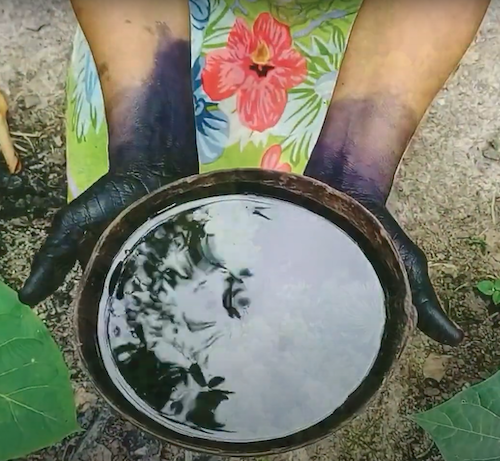
asakiyumeIt was a peak linguistic delight to listen to a presentation, given in Portuguese by a charismatic Colombian researcher named Mayra Ricardo Zuluaga, on a film she and a Tikuna scholar (meaning, in this case, a scholar who is Tikuna) named Sandra Fernández Sebastián had made about huito (in Tikuna, é), the fruit that's so important in Tikuna culture. It makes a deep, blue-black dye, and painting this on you confers protection and blessings. It's used on babies for this purpose, and in coming-of-age ceremonies and at other important events. (And/but it can be given more casually, too: I got to grate huito, squeeze the pulp, and dye my hands with it.) The film was in Spanish, with some phrases in Tikuna.
huito/é (screenshot from the film)
grated huito/é (my own photo)

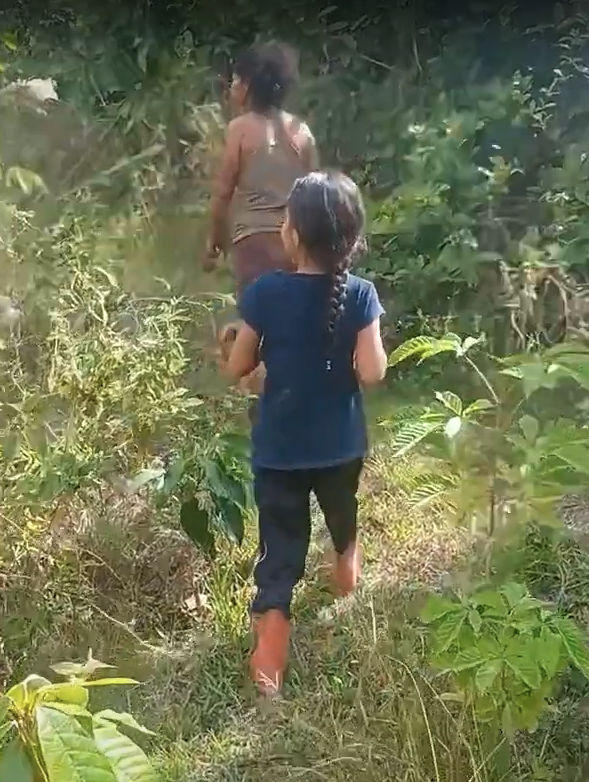
I really loved both the film (which you can see here) and Mayra's talk (which you can see here). Mayra describes going to meet Sandra with all the focus of someone educated in the European-heritage way, and Sandra got her to slow. down. The two spent time together, got to know each other, and Mayra got to learn in a different way. "Reading for the Magütá (autonym for Tikuna) doesn't begin with books, it begins with the body," she said, and "a child reads the threads of the forest."
reading the threads of the forest (screenshot from the film)
And Sandra says about maintaining the Magütá/Tikuna language, "If one doesn't talk the language, well, one loses the land,** because our mother tongue is the way we communicate with those spirits who don't speak Spanish."
Sandra harvesting huito/é (screenshot from the film)

I found a PDF made in conjunction with the film which contained contact information, so I sent a thank-you email to the two creators, and Mayra wrote back! And she linked me to more language-learning materials, records from an online class offered a couple of years ago by a French researcher. Who of course conducts the class in French! I had laugh (and thank my lucky stars I learned French in high school). A bouquet of languages to learn another language.
The butterfly is a blue morpho--if it opened up its wings, you would see the brilliant blue. And the pink wall is one wall of the Museo Etnográfico in Leticia. (screenshot from the film)

...In the European-heritage way of learning things. While meanwhile, with my friend and tutor in Leticia, we go slow, and I learn through friendly conversation. We're a continent apart, so we're not walking together, but we ask each other, "What are you doing right now?" "Numa, tacu tai cu u?" (there should be bunches of diacritics on those vowels, but my teacher is pretty haphazard about them, and I'm not sure with my ears about what they represent, so... ) or "What are you cooking?" "Tacu tai cui feim?" And then we answer each other, and we get a big laugh if we're cooking the same thing, which has happened.
**she says "territorio," but she's meaning everything that goes with territory/land: connection, sense of self, tradition, way of living.
huito/é (screenshot from the film)
grated huito/é (my own photo)
I really loved both the film (which you can see here) and Mayra's talk (which you can see here). Mayra describes going to meet Sandra with all the focus of someone educated in the European-heritage way, and Sandra got her to slow. down. The two spent time together, got to know each other, and Mayra got to learn in a different way. "Reading for the Magütá (autonym for Tikuna) doesn't begin with books, it begins with the body," she said, and "a child reads the threads of the forest."
reading the threads of the forest (screenshot from the film)
And Sandra says about maintaining the Magütá/Tikuna language, "If one doesn't talk the language, well, one loses the land,** because our mother tongue is the way we communicate with those spirits who don't speak Spanish."
Sandra harvesting huito/é (screenshot from the film)
I found a PDF made in conjunction with the film which contained contact information, so I sent a thank-you email to the two creators, and Mayra wrote back! And she linked me to more language-learning materials, records from an online class offered a couple of years ago by a French researcher. Who of course conducts the class in French! I had laugh (and thank my lucky stars I learned French in high school). A bouquet of languages to learn another language.
The butterfly is a blue morpho--if it opened up its wings, you would see the brilliant blue. And the pink wall is one wall of the Museo Etnográfico in Leticia. (screenshot from the film)
...In the European-heritage way of learning things. While meanwhile, with my friend and tutor in Leticia, we go slow, and I learn through friendly conversation. We're a continent apart, so we're not walking together, but we ask each other, "What are you doing right now?" "Numa, tacu tai cu u?" (there should be bunches of diacritics on those vowels, but my teacher is pretty haphazard about them, and I'm not sure with my ears about what they represent, so... ) or "What are you cooking?" "Tacu tai cui feim?" And then we answer each other, and we get a big laugh if we're cooking the same thing, which has happened.
**she says "territorio," but she's meaning everything that goes with territory/land: connection, sense of self, tradition, way of living.


no subject
Date: 2023-11-20 05:29 pm (UTC)I *love* that you're using a second language (Spanish) to learn a third language (Tikuna), and now have the opportunity to use yet another language (French) to also learn Tikuna! While presumably also brushing up your French, since it must be rusty at this point. So many different layers of language and culture. And the way that you're learning Tikuna from your tutor is just fascinating, much closer to the way children learn languages than a formal academic language class. Just chatting about things as the day goes on. I'll narrate like this to my niece Tinsley.
no subject
Date: 2023-11-20 07:57 pm (UTC)And we'll see--I only dipped into the recording of a zoom class, enough to hear the professor speaking and recognize WAIT A MINUTE, C'EST FRANÇAIS. I'm kind of hoping I'll be able to coast along on context because my French is suuuuper rusty.
And yes, re: talking with Francy. Much more like that 💛
no subject
Date: 2023-11-20 06:02 pm (UTC)no subject
Date: 2023-11-20 08:00 pm (UTC)no subject
Date: 2023-11-20 06:46 pm (UTC)no subject
Date: 2023-11-20 08:01 pm (UTC)no subject
Date: 2023-11-21 02:19 am (UTC)no subject
Date: 2023-11-21 05:55 am (UTC)no subject
Date: 2023-11-21 06:24 am (UTC)I think that is wonderful. So is the picture of the butterfly on the blue-black hand, against the bright wall. (What were you grating yours for?)
no subject
Date: 2023-11-21 06:37 am (UTC)While I was grating, the woman told me, "Some people the huito likes and some people not--if it doesn't like you, it won't take. There was this one woman from France..." And I thought, Great, no pressure. And also: PLEASE LIKE ME. The thing is, like with walnut juice, when you first put it on you, it doesn't seem to be doing anything (Ahhhhh, it doesn't like me), but then...
no subject
Date: 2023-11-21 06:38 am (UTC)You look like a bog body!
no subject
Date: 2023-11-21 06:43 am (UTC)no subject
Date: 2023-11-21 06:48 am (UTC)That is a marvelous photo of you.
no subject
Date: 2023-11-21 06:52 am (UTC)Terroir
Date: 2023-11-21 09:12 am (UTC)And so so so that about languages. They come from a world or worlds of which the humans are part, and are products of that world and enculturated human attempts to understand and work with it, with hysteresis.
I haven't checked, but suddenly I wonder whether philosophers (and civilian disputants) who attempt to reduce philosophy to language and its policing don't tend to monolingualism.
A technical question, because as a lover of the northeast of Brazil (via Jorge Luis Borges) I have been tempted for decades by Portuguese: How difficult is it for you to keep Portuguese and Spanish, or Portuguese and Italian from miscegenation? I found Spanish and Italian a problem requiring some partitioning, until quite recently....
And this reminds me:
A brief ST: TNG / A.A. Mine crossover
Re: Terroir
Date: 2023-11-21 01:35 pm (UTC)So far my use of Portuguese has been entirely receptive--that is, I've been listening to people speaking and understanding what they're saying--and for that, there's no problem at all. But at first when I would try to speak Spanish (some years ago now), any time I ran into difficulties, Japanese would be raising its hand and shouting "oh, oh, pick me, pick me" so aggressively that it was hard to pick quiet little Spanish, even when in fact it had an answer for me. It definitely felt like Japanese was saying, "I'm the dominant foreign language in this house folks! You all take a place in the back." That doesn't happen any more; Spanish is just much more available for me to speak now--I can do it much more confidently (although with much less grammatical correctness than with Japanese).
I've sometimes had a Portuguese word slip in--I was asking Francy for colors the other day, and I asked for amarelo instead of amarillo, and sometimes I slip up and say -dade Portuguese words when I want -dad Spanish words. Probably the same thing would happen in the other direction if I were ever in a situation to speak some Portuguese. All I managed when I was actually in Brazil were some obrigadas and an um pouco in response to an exclamation that I knew Portuguese (I was only very briefly there, and in the company of Spanish speakers).
Darmok
Date: 2023-11-21 01:40 pm (UTC)no subject
Date: 2023-11-22 01:19 pm (UTC)no subject
Date: 2023-11-22 01:23 pm (UTC)no subject
Date: 2023-11-27 03:56 am (UTC)no subject
Date: 2023-11-27 02:25 pm (UTC)Your comment got me thinking about polysyllables and monosyllables and what concepts are expressed with monosyllables in the languages I know and what things are expressed polysyllabically, and then that led me to where we draw the borders around concepts, and how that's not the same across languages.
And also I started musing on language evolution and what "important" means, etc. It all feels a little hard to get a grip on! Or maybe it's that it feels like some things make some kinds of intuitive sense, but if one tries to probe further, it gets hard.
So many thoughts!
no subject
Date: 2023-11-29 03:56 pm (UTC)no subject
Date: 2023-11-29 04:46 pm (UTC)