![[personal profile]](https://www.dreamwidth.org/img/silk/identity/user.png)
saving to the murmuration
Jul. 28th, 2025 07:56 pm"Holy shit. This guy saved a PNG to a bird," read the beginning of a Bluesky post that linked to a 30-minute Youtube video about birdsong and starlings' capacity for mimicry. A guy drew a picture of a bird in a spectral synthesizer, which then will produce the sounds that the lines indicate.** The guy played those sounds for a starling, and lo and behold, the bird copied it--such that when you look at the spectrogram, you see a picture of a bird that's very close to the picture the guy had drawn.
So it's in that sense that the guy saved an image to a starling.
I'm charmed that this involves translation from a visual medium to a sound medium. "We can save your picture, but only if you sing it." --This concept of translation is familiar to us, of course. Data that's stored digitally is translated into zeros and ones, then translated back into something we can understand--words, images, sounds, formulae.
... If we were going to use starlings to save our data, we'd have to beg not individual starlings but whole murmurations.
Imagine if you had to sing or say all your data to save it. Imagine going out and standing on a hill and taking a deep breath and just singing out, hoping that the murmuration would deign to listen and retain what you were singing. It would be like an incantation or an invocation or a prayer.
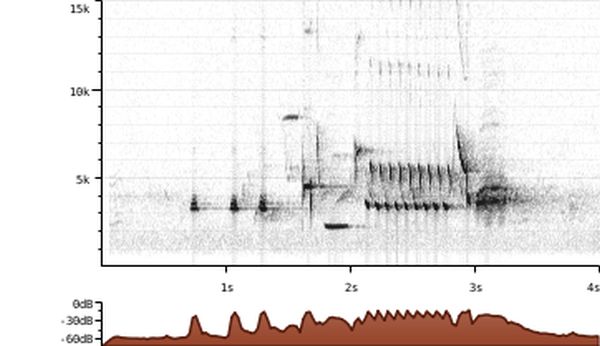
**A spectrograph of a bird's call looks like, for example, this:
(Song sparrow spectrograph from this web page)
So the guy drew the bird below and then played the sounds that this set of lines makes...

And the starling sang back this:
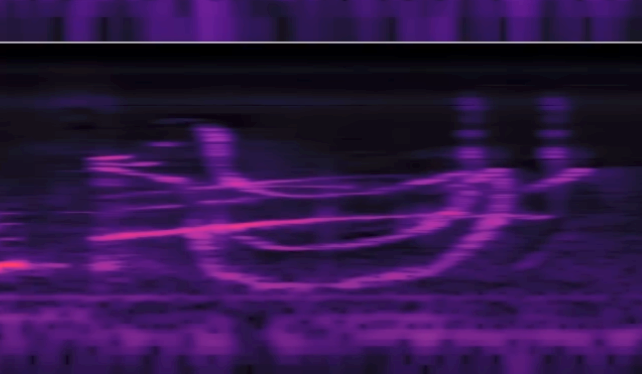
(Images are screenshots from the Youtube video.)
So it's in that sense that the guy saved an image to a starling.
I'm charmed that this involves translation from a visual medium to a sound medium. "We can save your picture, but only if you sing it." --This concept of translation is familiar to us, of course. Data that's stored digitally is translated into zeros and ones, then translated back into something we can understand--words, images, sounds, formulae.
... If we were going to use starlings to save our data, we'd have to beg not individual starlings but whole murmurations.
Imagine if you had to sing or say all your data to save it. Imagine going out and standing on a hill and taking a deep breath and just singing out, hoping that the murmuration would deign to listen and retain what you were singing. It would be like an incantation or an invocation or a prayer.
**A spectrograph of a bird's call looks like, for example, this:
(Song sparrow spectrograph from this web page)
So the guy drew the bird below and then played the sounds that this set of lines makes...
And the starling sang back this:
(Images are screenshots from the Youtube video.)
Tags:


