champagne

Jan. 1st, 2026 12:21 pm
asakiyume: (cloud snow)
Happy 2026 ... the microfiction prompt word today was "champagne." I ended up in South Dakota on Google Street View, and then downloading the New Lakota Dictionary to hear how a word was pronounced but ... have a microstory:
Driving through Bullhead, South Dakota, Mike noticed a sign on a roadside stand: "Bullhead Champaign."

He pulled over. Bottles with fancy labels in both English & Lakota stood in a row.

"You know you can't call something champagne unless comes from Champagne, France, right? Also, isn't this area too cold for wine grapes?"

The seller regarded Mike coolly.

"This is made from sandcherry. Aúŋyeyapi in our langauge. And it's p-a-i-g-n, not p-a-g-n-e. Totally different."

From this blog I learned the Lakota name, as well as an alternative name, tȟaȟpíyoǧiŋ, and this fun piece of lore: that you should pick the fruit facing the wind to ensure they'll be sweet.
asakiyume: (yaksa)
Yesterday I was responsible to get R to a first English class, only I was late.

go slow )

Any time we can slow stuff down and humanize it, even if it's only for a little bit, it feels like a victory.
asakiyume: (shaft of light)
Holy moly, a person from the Tukano Amazonian people just friended me on Bluesky, and she's learning Tikuna too! I was able to say to her that I thought Tikuna was tagarü mecuraum (a beautiful language). I apologized for my poor orthography (Tikuna is rendered into letters differently in Peru, Colombia, and Brazil, but what I write is not even correct by the Colombian orthography because my teacher is pretty random about spelling). This woman then kindly gave me the correct (for Brazil) orthography, plus a grammar correction: Tága rü mecüraū (I left out the ña... not entirely sure what it does/means, but learning is a slow and wondrous thing).

Truly, the internet remains a wondrous place for connecting with people! And now I know the Tukano word for cassava: kií. (Tikuna is a language isolate, so the chances of my Tikuna helping me know Tukano are slight, except for common loan words they both might have from, e.g., Tupi.)

I have other things to post about but I'm going to put the different flavors on different plates (i.e., save it for another post)
asakiyume: (Em reading)
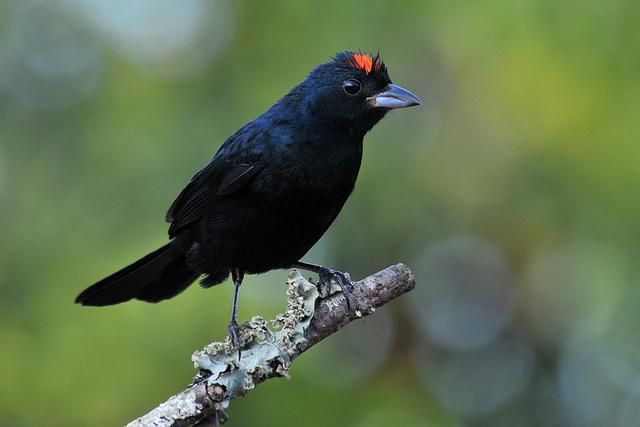
Look at this bird that came up on Aves do Brasil:


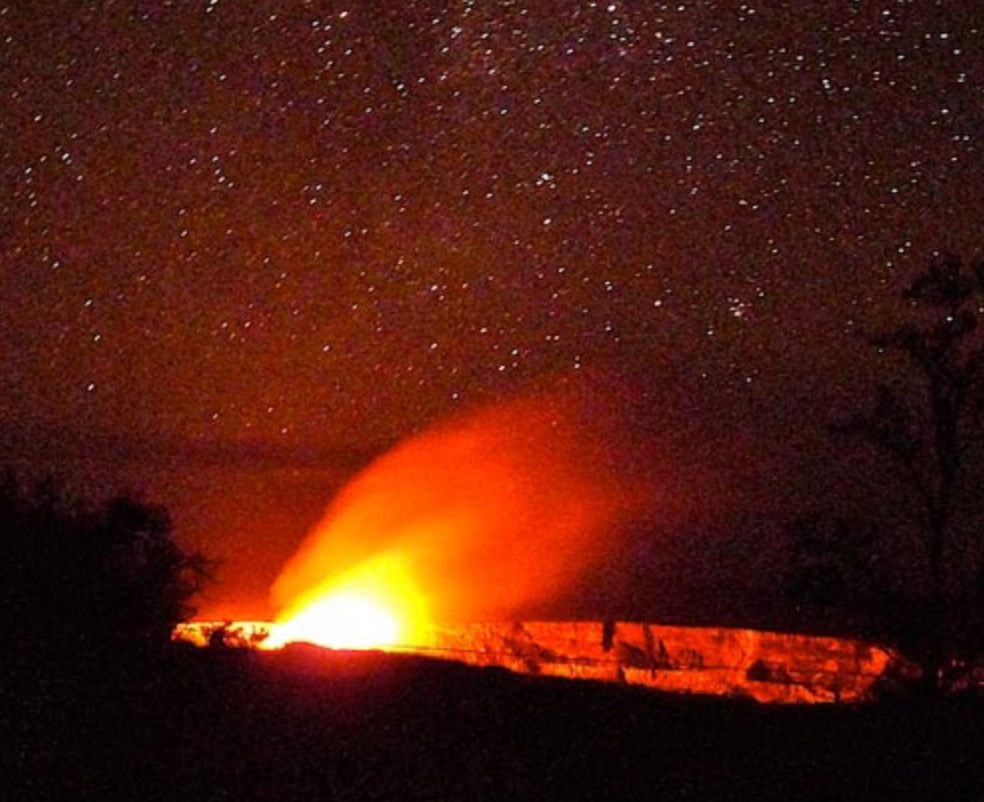
Doesn't he look like a volcano at night, with lava just waiting to overbrim?


I feel it's such a good representation of how we all are. All our hot feelings at the top of our heads.

In English he's called a ruby-crowned tanager. His Brazilian name, tiê preto, translates as "black tiê" (and the word "tiê" comes from a Tupi word, "ti'ye," but my very cursory investigations haven't turned up what that means). It's funny that the English name looks at that one bright patch and the Brazilian name looks at the rest of him.

In other news, sometimes negative reviews can make you want to read something. Someone I follow on Goodreads wasn't a fan of The Navigating Fox, but their description of it intrigued me--a world with talking animals who interact more or less as peers with humans (though, as in Narnia, there are also animals who don't talk). The main character is the titular Navigating Fox, Quintus Shu'al, who starts out the story in disgrace. Fingers crossed that the story ends up being good.

The cover is really pretty, too. Not that that's a reason to choose a book, I realize, but it makes it fun to look at.

asakiyume: (shaft of light)
The Tikuna language has five genders (these aren't genders like people having genders; these are just linguistic genders--like how French and Spanish have two** and German has three. Speaking of, it's fascinating to me when Spanish and Portuguese genders don't agree, like for "computer," which is masculine in Portuguese but feminine in Spanish. And "tree" is the opposite: masculine in Spanish but feminine in Portuguese.)

Anyway, Ticuna's five genders are feminine, masculine, neuter, salient, and nonsalient. What's interesting to me is that the prefixes for these only come in three variations: one for feminine, one for masculine, neuter, or nonsalient, and one for salient. It's a taxonomy that would make Borges smile! There are things in the feminine category, things in the masculine/neuter/nonsalient category, and things in the salient category. (Things owned by the emperor would be .... let's guess salient.)

... This information comes from the 2020 online course, not from work with my tutor. She, however, continues to teach me fun words and phrases, like michi pucuum na muum--the cat is afraid of the rain.

**Not so fast, Asakiyume--and readers! [personal profile] mount_oregano points out that actually Spanish has five genders (see her comment here; she links to an explanation.)
asakiyume: (yaksa)
A couple of times recently, I played Jiji cat tv on Youtube--videos of mice and squirrels and birds moving about. He was *fascinated*. Since then, he's been very interested in whatever's going on on my screen. If I'm just typing (as I am now, writing this entry), he will paw at the moving cursor.

I'm slowly working my way through the Tikuna lessons that Mayra Ricardo Zuluaga linked me to, the ones in Spanish and French. So yesterday, I was listening to/watching one, and Jiji hopped up onto the desk and started studying the screen, looking for mice, squirrels, or cursors.

I took a picture because it look so much like Jiji was super into what the professor was talking about.

And what the professor was talking about in that moment was quite interesting... )

Jiji studies Tikuna
asakiyume: (shaft of light)
I've started listening to Denis Bertet's 2021 Tikuna classes. OMG great French review because he says everything in French and then translates into Spanish, so if there's something I don't remember, I can catch it the second time around.

First class he shared a video of a man sitting in his house, introducing himself, and asked the students for things they noticed about the language on first hearing (although the class included both people who were familiar with the language and/or culture and absolute beginners), and also things they noticed in the situation.

One of the students mentioned about the microphone that the man is wearing, and Prof. Bertet says that it's a super great microphone, really good for situations like this, because it picks up just the speaker's voice (or mainly just that), whereas there's a lot of ambient noise--hens, dogs, children, birds, rain--which can interfere with hearing.

And I was thinking HOW MUCH I LOVE that about getting WhatsApp messages from my tutor, how it makes me smile, how it makes me feel that much closer. Someone drops a cup in the background and I can hear it bouncing on the floor. Chicks are peeping as they're fed. The rain is coming down. The birds are singing.

It is definitely valuable to be able to hear clearly what someone is saying, and I'm going to learn a lot from these recordings, I can tell already (not to mention other cultural stuff, like that daytime-use hammocks are called--in Spanish--chinchorro... looking online I find that the name comes from a type of hammock made by the Wayuu people), but if I had to choose only one way of learning, I'd choose learning with my tutor in a heartbeat. ... But I don't have to choose. Both are possible! And not just both but many. Multiplicity! So many different ways of doing things. In any given moment, we may have to choose one method or thing or another, but at some other moment we can choose something else. A little of this, a little of that. Or a lot of this for XX years... and then something different.
asakiyume: (shaft of light)
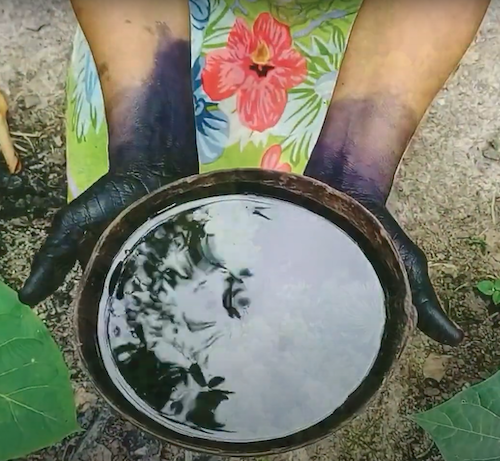
It was a peak linguistic delight to listen to a presentation, given in Portuguese by a charismatic Colombian researcher named Mayra Ricardo Zuluaga, on a film she and a Tikuna scholar (meaning, in this case, a scholar who is Tikuna) named Sandra Fernández Sebastián had made about huito (in Tikuna, é), the fruit that's so important in Tikuna culture. It makes a deep, blue-black dye, and painting this on you confers protection and blessings. It's used on babies for this purpose, and in coming-of-age ceremonies and at other important events. (And/but it can be given more casually, too: I got to grate huito, squeeze the pulp, and dye my hands with it.) The film was in Spanish, with some phrases in Tikuna.

huito/é (screenshot from the film)


grated huito/é (my own photo)
grating huito

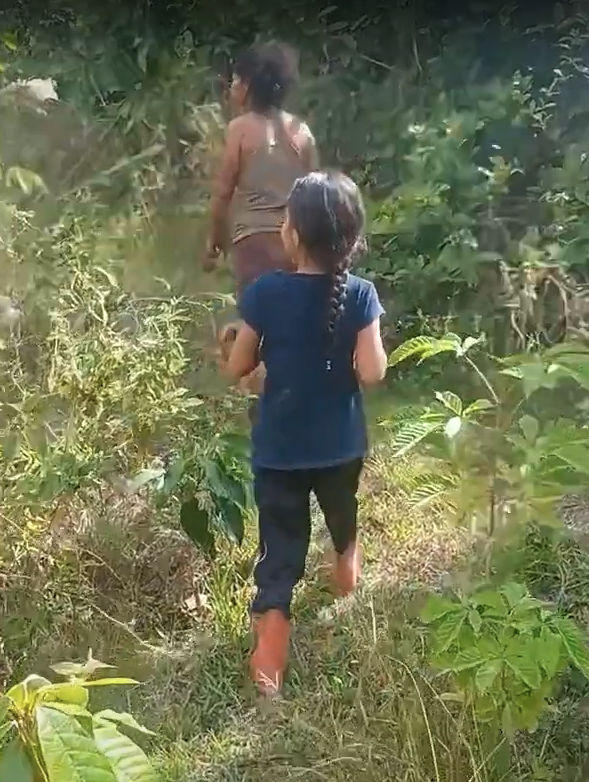
I really loved both the film (which you can see here) and Mayra's talk (which you can see here). Mayra describes going to meet Sandra with all the focus of someone educated in the European-heritage way, and Sandra got her to slow. down. The two spent time together, got to know each other, and Mayra got to learn in a different way. "Reading for the Magütá (autonym for Tikuna) doesn't begin with books, it begins with the body," she said, and "a child reads the threads of the forest."

reading the threads of the forest (screenshot from the film)


And Sandra says about maintaining the Magütá/Tikuna language, "If one doesn't talk the language, well, one loses the land,** because our mother tongue is the way we communicate with those spirits who don't speak Spanish."

Sandra harvesting huito/é (screenshot from the film)


I found a PDF made in conjunction with the film which contained contact information, so I sent a thank-you email to the two creators, and Mayra wrote back! And she linked me to more language-learning materials, records from an online class offered a couple of years ago by a French researcher. Who of course conducts the class in French! I had laugh (and thank my lucky stars I learned French in high school). A bouquet of languages to learn another language.

The butterfly is a blue morpho--if it opened up its wings, you would see the brilliant blue. And the pink wall is one wall of the Museo Etnográfico in Leticia. (screenshot from the film)


...In the European-heritage way of learning things. While meanwhile, with my friend and tutor in Leticia, we go slow, and I learn through friendly conversation. We're a continent apart, so we're not walking together, but we ask each other, "What are you doing right now?" "Numa, tacu tai cu u?" (there should be bunches of diacritics on those vowels, but my teacher is pretty haphazard about them, and I'm not sure with my ears about what they represent, so... ) or "What are you cooking?" "Tacu tai cui feim?" And then we answer each other, and we get a big laugh if we're cooking the same thing, which has happened.

**she says "territorio," but she's meaning everything that goes with territory/land: connection, sense of self, tradition, way of living.
asakiyume: (Dunhuang Buddha)
I dreamed there was a book, an Edwardian guide to the meanings of buttons, the way there are guides to the meanings of flowers. I was looking at the cover, which had lovely old lettering and slightly bad printing (colors not quite aligned). I knew without opening it that it would say what bone buttons mean, and wood, cloth-covered ones, metal ones, clay and ceramic. What it means if the pattern is a crest of arms or flowers, nautical themed or woven.


"There was a guy, the buttons on his jacket were bits of rebar from the Twin Towers, inset with Etruscan glass. I recall too that he had feather earrings. He bragged they were pinfeathers from a royal northern albatross."

asakiyume: (shaft of light)
In order for me to learn how to say things in Tikuna, my teacher sends me short recordings over WhatsApp. I then save them in files on my phone and computer and listen to them over and over and try to copy what she's saying.

These recordings are so, so charming, they always make me smile. She starts off with good morning, good afternoon, good evening (in Spanish), and in the background there may be music, or kids playing, or the sounds of cooking, or the sound of rain, or birds and insects. Sometimes she's whispering because she's sending me a message late. I never realized how VERY QUIET my own environment was until I started getting these lively recordings--such a gift.

And then there's how she frames what she's teaching me. She had just explained to me how to say "I want to eat pineapple (followed by fish, and then grilled chicken--"I'm getting hungry!" I told her), and next she wanted to tell me how you would ask someone "Do you want to eat pineapple?" She introduced the phrase by saying, "When you want to ask someone if they want to eat pineapple, for example, your niece, your child, your uncle... [brief pause], your husband ... [another pause] your dog, your grandfather, your grandmother, you ask--" want to know how to ask it? )

I was grinning and grinning at that very broad and inclusive list. She's very close with her nieces and her boyfriend's nieces; I'm not surprised she put them first ^_^
asakiyume: (yaksa)
My friend Francy is looking for work, and I am eager to learn Tikuna without taking advantage of her, so I proposed to pay for a month or so of lessons (I don't want to saddle her with a long-term obligation and don't know how long I can afford to do this) as a source of income while she looks.

I should have known from how graciously and easily she taught me words when I was visiting that she'd be an excellent teacher, but I've been truly blown away. She's made me two diagrams of the forest field site where I got to join in the fariña roasting, labeling everything in both Spanish and Tikuna, and she sent me a video where--as the rain beats down on the roof overhead--she goes over how to pronounce each word, slowly and clearly.

Here's a portion of the diagram: you can see the yuca plant with the big tubers, the fariña being sieved through the cernador (in Tikuna, cuechinü), and that figure is me !

Yuca, fariña, me


I also should have known she'd be an excellent teacher because she's taken one of her nieces in hand, helping her with school work. (This is one of the kids who was so eager to show me her notebooks ^_^)

helping niece


There are NOT a lot of resources in Tikuna. When I visited the community of Mocagua (a community with three indigenous peoples living together, Tikuna, Cocama, and Yagua), I got to see some textbooks that the kids in the community used, but they were few and consequently very precious: they had been created through the work of a foundation, Codeba, itself the creation of one remarkable Cocama woman, Emperatriz Cahuache. When she passed away, no one kept the foundation going, so there haven't been any more textbooks made.

The books share Tikuna traditions, and also provide general instruction in both Spanish and Tikuna. Here, an explanation of the water cycle:

The water cycle: explanation in two languages )

I asked if there was a Spanish-Tikuna dictionary, and they showed me a children's picture dictionary. Behold a káurë bird, *just like in my story*. It's so vindicating when research doesn't lie to you.

kaure

And some more ^_^

other birds


I don't know how for-real for-real I can learn Tikuna. But I am really loving trying. It's a language for speaking about a life so totally different from my own! (And the sounds are more-different from English than the sounds of any other language I've ever learned.)

In the Peace Corps manual for learning Tetun, there's a very good piece of advice: Don't ask people, "How do you say XX in Tetun?" Don't do this, because if you ask like that, they will offer you a word-for-word version of how to say that... even if culturally speaking, such a thing is never said. (A big example relates to condolences: in Tetun you never say "I'm so sorry for your loss"--it sounds as if you're saying you're taking some kind of responsibility for it.) Instead, ask, "In XX situation, what do people usually say?" Then you'll learn something culturally appropriate.

I am thinking that's going to be what I need to ask ALL THE TIME for however we do lessons together.
asakiyume: created by the ninja girl (Timor-Leste nia bandiera)
During the summer I took the level-one Tetun course (Tetun: the lingua franca in Timor-Leste) offered through Timorlink. It's an Australia-based program, but the teachers all have deep connections with Timor-Leste.

Next week I'm starting the level-two course, and--because life is stranger than fiction--my teacher is going to be none other than the inestimable Kirsty Sword Gusmão.

Life keeps thrilling me--I feel so lucky to be alive!

Profile

asakiyume: created by the ninja girl (Default)
asakiyume

March 2026

S M T W T F S
1 2 345 67
891011121314
15161718192021
22232425262728
293031    

Syndicate

RSS Atom

Most Popular Tags

Style Credit

Expand Cut Tags

No cut tags
Page generated Mar. 13th, 2026 07:35 am
Powered by Dreamwidth Studios