Unlocked, by Jerry Zaltman
Jul. 9th, 2018 06:57 pm![[personal profile]](https://www.dreamwidth.org/img/silk/identity/user.png) asakiyume
asakiyumeI don't usually edit whole books, but every now and then it happens, and this was one such case: Unlocked: Keys to Improve Your Thinking. I really enjoyed working on this book and have used some of the exercises in it with students I volunteer with, always with wonderful, thought-provoking results.
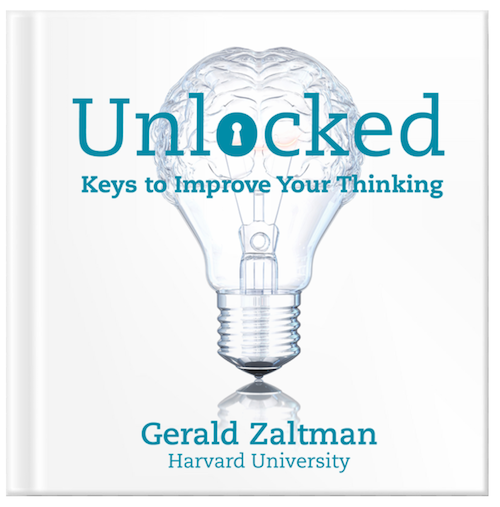
The intention of the book is to get people thinking about how they think, to understand how things like priming and cues work, to learn about the faultiness of memory and the selectivity of attention and so on, in the hopes that understanding how we think can help us think better. In the preface the author says,
This book wants to change that.
I'm imagining that people reading here probably will, like me, be familiar with some of the thought experiments and information about thinking that the author presents, but probably/maybe (like me) not all of them. And they're entertainingly presented (though my nemesis, the trolley problem, makes an obligatory appearance).
One perk of doing the editing is that I have some books to give away! Both actual, physical books, which are better for some things (like writing down stuff when you're asked to write down stuff), and ebooks, which are better for other things (like hyperlinks and seeing stuff in color--the physical book is in black and white, but the ebook is in color).
Below the cut is an excerpt from the first "Think Key," which features an ethical dilemma that's a little less high-stakes than the one in the trolley problem. It'll give you a sense for what the book is like. To enter the giveaway, just express interest in a comment. In two weeks' time, I'll put names in a hat and pull three and post the results in a new entry. I'll also try to contact winners privately. You'll get both the physical book and the ebook.
I'm going to skip the introduction and take you right to the exercise:
And now I'm going to skip the Basic Idea section and take you to the So What? section
If you want to take a further look at the book, you can visit Amazon or the author's website.
The intention of the book is to get people thinking about how they think, to understand how things like priming and cues work, to learn about the faultiness of memory and the selectivity of attention and so on, in the hopes that understanding how we think can help us think better. In the preface the author says,
People can react negatively to complexity and to rapid social and scientific change—for example, by retreating into rigid, deeply entrenched thinking, which leads to diminished curiosity and intolerance of those who think and act differently. Still more worrisome is an unconscious, invisible reluctance to challenge our own thoughts and feelings. Thinking, it seems, is far too often employed to justify an existing position rather than to explore, improve, and perhaps change it.
This book wants to change that.
I'm imagining that people reading here probably will, like me, be familiar with some of the thought experiments and information about thinking that the author presents, but probably/maybe (like me) not all of them. And they're entertainingly presented (though my nemesis, the trolley problem, makes an obligatory appearance).
One perk of doing the editing is that I have some books to give away! Both actual, physical books, which are better for some things (like writing down stuff when you're asked to write down stuff), and ebooks, which are better for other things (like hyperlinks and seeing stuff in color--the physical book is in black and white, but the ebook is in color).
Below the cut is an excerpt from the first "Think Key," which features an ethical dilemma that's a little less high-stakes than the one in the trolley problem. It'll give you a sense for what the book is like. To enter the giveaway, just express interest in a comment. In two weeks' time, I'll put names in a hat and pull three and post the results in a new entry. I'll also try to contact winners privately. You'll get both the physical book and the ebook.
I'm going to skip the introduction and take you right to the exercise:
Brooke and Jared are sister and brother. Brooke has just turned twelve and Jared is almost fourteen. It is Brooke’s birthday, and Jared is taking her to lunch as a treat. Brooke is very excited. Their family seldom can eat out even at fast-food restaurants. Jared has worked very hard to save enough money to take Brooke to lunch, which also requires round-trip bus fares for each of them. It will be a long time before he can save up enough money to do this again.
Brooke absolutely loves burgers. However, she is not an adventuresome eater. In fact, some people say she is a very fussy eater. A new burger joint has opened. It is very popular with her friends, and she hasn’t been there yet. The restaurant has quickly become known for its Zomburgers. A Zomburger is made from ground-up caterpillars. It is considered very, very healthy. The burger joint even has its own caterpillar farm to assure freshness and quality. Interestingly, a cooked Zomburger looks and tastes just like a regular burger and is served the same way. After it is cooked no one can tell the difference. The only thing that sets the Zomburger apart is that it is so very healthy and, of course, what goes into it.
Jared really wants Brooke to join him in having a Zomburger. But after a long discussion at
the restaurant in which Brooke often uses the words “disgusting” and “absolutely not!” Jared fails to convince her to try one. She says she’d rather starve. He goes to the counter and orders a regular burger for Brooke and a Zomburger for himself. And French fries for them both.
After picking up the order he heads back to their table. However, while bringing the burgers to their table, Jared realizes he has forgotten which one is the Zomburger. He knows the restaurant people can’t help now because the burgers look alike. And he doesn’t have any money left to order another regular burger for Brooke.
As Jared arrives at their table, Brooke is looking very pleased and very, very hungry. She can’t wait to dig in.
What should Jared do?
- Give her a burger, pretending it is the regular burger. In other words, keep his confusion about the burgers to himself. He is certain she won’t know the difference. How would you justify this decision if you were Jared? How certain are you that this is the best decision?
- Admit his confusion and let Brooke choose what to do. He knows she feels the Zomburger is disgusting. He will likely end up eating both burgers himself while Brooke goes hungry on her birthday. How would you justify this decision? How certain are you that admitting his confusion right away is the best decision?
- Should he tell her only while she is eating that he doesn’t know which one she has? What emotions do you think Brooke will feel if he does this?
- What emotions will she feel if he tells her afterwards, say on the way home on the bus?
- Will her emotional reaction change if he tells her a few years later?
- How might Jared’s feelings be different depending on whether he tells her before she starts eating, halfway through the burger, or right after she finishes?
- On Brooke’s part, should she give a logical reason to Jared for not wanting a Zomburger? Is it enough to say that she finds it disgusting without having to say why? Does she owe him more explanation?
- If Jared tells Brooke the problem he has before giving her a burger, how do you think Brooke will feel or should feel about Jared?
- How might the situation differ if Jared and Brooke bought the burgers to eat at home, and Jared only realized his confusion then?
And now I'm going to skip the Basic Idea section and take you to the So What? section
Thinking about Jared’s situation and how to handle it is one thing, but more broadly, this exercise should prompt you to question how you’ll prepare yourself for being in a similar situation. What can you do? When such an occasion does arise, a good question to ask is: What is the foundational principle for me here? That is, what core value do I want to express or use to guide my decision? For Jared it might be, “Never trick anyone to ingest food they don’t like.” Of course, it could also be, “Don’t ruin a very special birthday outing for your sister.”
If you want to take a further look at the book, you can visit Amazon or the author's website.


no subject
Date: 2018-07-10 12:37 am (UTC)I actually think we'd be better equipped to handle RL dilemmas if we started with the sort we actually encounter, and then really thought through the implications and how we'd handle them, and whether we'd be willing too. Because in RL, the reason ethical dilemmas are dilemmas is not usually that they're confusing and it's unclear what the right thing to do is, it's that one choice comes at a price that you're not sure you're willing to pay.
IMO, the more RL version of the Zomburger dilemma would be that Jared could buy his sister another burger, but he'd then have to sacrifice something he really wanted to use that money for. Are you willing to do that, when the Zomburger is harmless and there's a 50-50 chance she won't get it anyway?
no subject
Date: 2018-07-10 01:49 am (UTC)And your last-paragraph scenario reminds me of one person's answer to this question, which was to point out that Jared, too, is losing something--the chance to be sure he's trying a Zomburger.
no subject
Date: 2018-07-10 11:50 am (UTC)no subject
Date: 2018-07-10 01:38 pm (UTC)no subject
Date: 2018-07-10 01:47 am (UTC)(And at least this one isn't cruel, like the "would you save the drowning dog or the drowning thief, you can only save one," which I hated with incandescent hatred, back in the day).
no subject
Date: 2018-07-10 02:31 am (UTC)no subject
Date: 2018-07-10 04:14 am (UTC)How cool that you got to edit this. I'm expressing my interest!
no subject
Date: 2018-07-10 09:32 am (UTC)The author of this book is a professor emeritus of marketing, so I am absolutely sure if the Zomburger joint were to ask him for advice, that would be one of the first things he'd recommend.
no subject
Date: 2018-07-10 06:00 am (UTC)no subject
Date: 2018-07-10 09:33 am (UTC)no subject
Date: 2018-07-10 09:04 am (UTC)More seriously, this is me, quite often when I'm getting coffee for friends. "And this is the skim... or was it this one? Umm..." Solving the problem together is always the best way...
no subject
Date: 2018-07-10 09:34 am (UTC)no subject
Date: 2018-07-10 11:48 am (UTC)The title made me think Ugh, but your description made it clear that I'd enjoy this a lot.
no subject
Date: 2018-07-10 01:31 pm (UTC)no subject
Date: 2018-07-10 02:36 pm (UTC)I'd let Brook have one of the burgers and wouldn't mention the fact that I didn't know which was which.
If she knew years later, she'd be mature enough to react better.
That's me.
: /
no subject
Date: 2018-07-10 03:01 pm (UTC)no subject
Date: 2018-07-10 06:56 pm (UTC)But my first answer to the problem was for Jared to tell Brooke he’s gotten confused and then try both of the burgers and give her the one that tastes most like a normal burger. But I also like sartorias’s suggestion of just taking the burgers back to the counter and asking them to mark the new ones.
no subject
Date: 2018-07-10 07:12 pm (UTC)According to the story, Zomburgers taste exactly like regular hamburgers (although, of course, not all hamburgers taste identical, so there's that). I think a more real-life example would be something like a pie crust that could either be made with lard or butter, and the person's a vegetarian. The pie crust might not taste discernibly different, but the vegetarian wouldn't want to eat it if it was made with lard.
I definitely think marking the Zomburgers in the future is the way to go! It doesn't solve Jared's problem, but it means no future people would suffer the same fate.
no subject
Date: 2018-07-11 06:50 pm (UTC)no subject
Date: 2018-07-10 07:37 pm (UTC)Staying within the options given in the exercise, I say No Way! to #1 and #3. That's because I wouldn't want someone to do that to me, and yet I'm aware some people would rather be lied to or managed.
no subject
Date: 2018-07-11 11:26 am (UTC)no subject
Date: 2018-07-10 08:38 pm (UTC)Thanks for all your recent posts--I've been enjoying them, despite my comment-silence until now!
no subject
Date: 2018-07-11 11:15 am (UTC)no subject
Date: 2018-07-11 07:04 am (UTC)I am afraid I now think of the trolley problem as lurking inexorably in your path in the same way as the trolley in the problem. [edit] Do you have to push another thought experiment in its way?
no subject
Date: 2018-07-11 11:13 am (UTC)And to your edit, I guess I just did. "I don't know about switching tracks...but HERE have a caterpillar burger! That'll stop you!"
Seriously, though. Pushing the fat person/large person onto the tracks is such a fat-phobic element. Like, if five people are at risk from this trolley, there is no way that one person can possibly be large enough to stop it. I know that's the kind of hair-splitting, nit-picking carping that ignores the spirit of the thought problem, BUT STILL. If we're just going to say "But for the sake of argument," then why not make this hypothetical person an alien whose body is extra dense? Of course then you're not going to be able probably to push them. But for that matter, how are you going to put the fat person?
TROLLEY PROBLEM!!! YOU GOT ME STARTED YET AGAIN! **shakes fist**
no subject
Date: 2018-07-11 05:11 pm (UTC)I would definitely try a caterpillar burger, for the record. I've eaten cricket chips. I would just want to know that's what I was eating, since in the real world the chances of me reacting idiosyncratically to something I have never eaten before are non-zero.
Seriously, though. Pushing the fat person/large person onto the tracks is such a fat-phobic element. Like, if five people are at risk from this trolley, there is no way that one person can possibly be large enough to stop it.
That must be a variant: I thought the original problem was simply the ethics of a five-for-one tradeoff. Is it supposed to make you think differently about the quality of the one life you're sacrificing to save five? (Ergh, if so.)
TROLLEY PROBLEM!!! YOU GOT ME STARTED YET AGAIN! **shakes fist**
We don't have to do the trolley problem! We can do the utility monster instead!
We can not do thought experiments!
no subject
Date: 2018-07-11 05:56 pm (UTC)Utility monster? **googles**
For instance, eating a cookie might bring only one unit of pleasure to an ordinary person but could bring 100 units of pleasure to a utility monster.
D'awwww! And I'm going to stop right there, before I find out things like that a utility monster gets 100 units of pain for every one I get or something like that. Have a cookie, utility monster.